

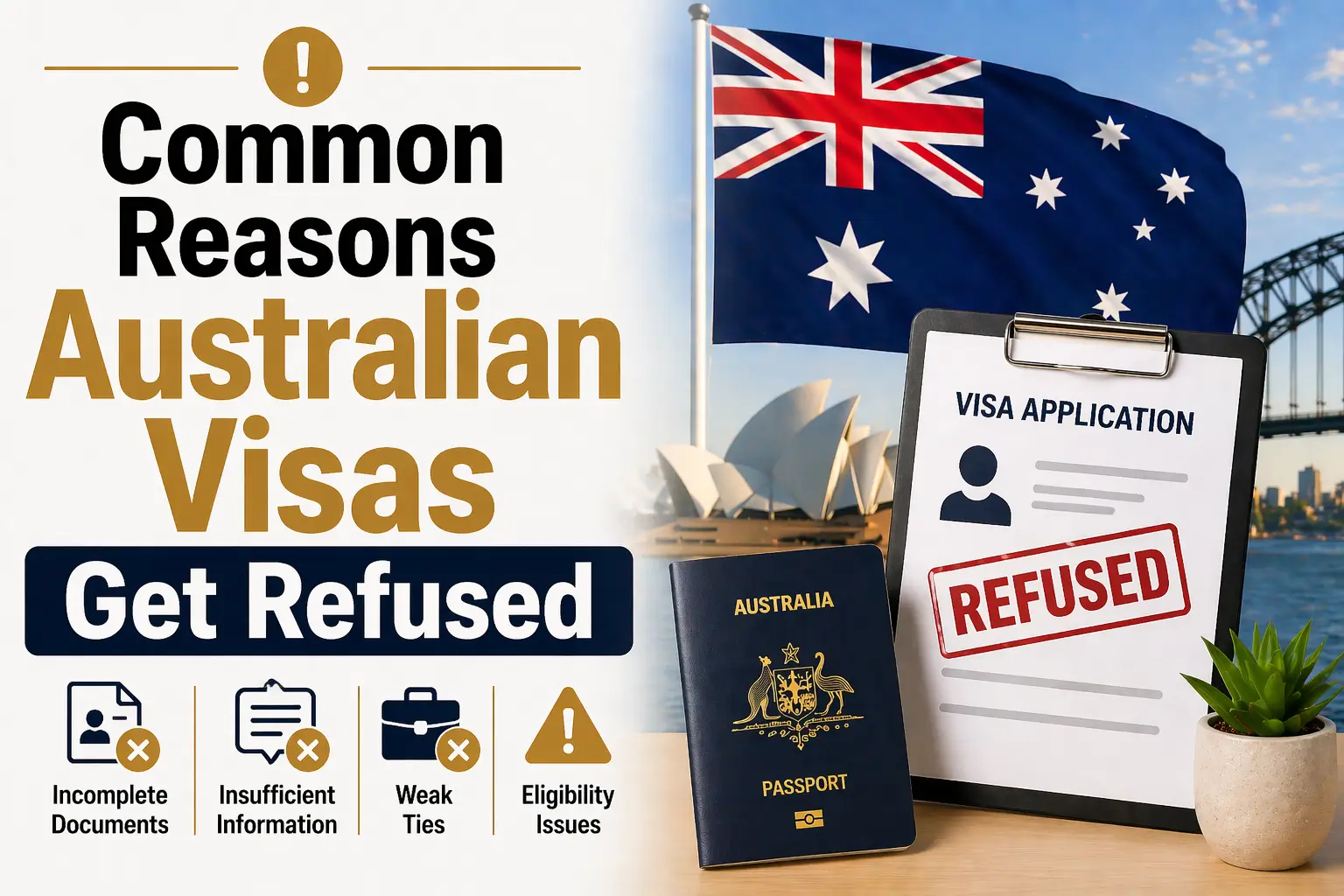
Visa refusals happen more often than people expect, and many of them are avoidable. Understanding the most common reasons behind refusal decisions gives you a genuine advantage when preparing your own application.
Failure to Meet the Genuine Temporary Entrant Requirement
This is the most common reason for student visa refusals and appears in other visa types too. The Genuine Temporary Entrant (GTE) assessment asks whether you genuinely intend to use the visa for its stated purpose and return home afterwards.
Decision-makers look at your economic and personal ties to your home country, your immigration history, your choice of course or destination, and whether your stated intentions are consistent with your circumstances. A vague or unconvincing GTE statement is one of the quickest ways to a refusal.
Inadequate Financial Evidence
For visas requiring proof of financial capacity, the most common mistake is providing financial evidence that does not actually demonstrate what it needs to demonstrate. Bank statements that show a recent large deposit that was not there previously raise questions about whether the funds genuinely belong to the applicant. Statements from a sponsor that do not include the sponsor’s own financial information are incomplete. Evidence that covers only one month when the application requires evidence of sustained financial position is insufficient.
Prior Refusal History Not Disclosed or Poorly Addressed
Every Australian visa application asks about previous visa refusals from Australia and other countries. Not disclosing a prior refusal is a character concern in itself. Disclosing it without adequately addressing it leaves the decision-maker wondering about the same concerns that caused the previous refusal.
Character Concerns
Criminal histories must be disclosed. The character test under section 501 can apply to a wide range of matters, including serious conduct that did not result in a conviction. Failing to disclose a criminal history, or disclosing it without providing context and evidence of rehabilitation, regularly leads to refusals.
Health Requirement Not Met
Panel physician assessments identify health conditions that engage the health criteria. Where this happens and no waiver application is made, or where a waiver application is not adequately supported, a refusal on health grounds follows.
Incomplete or Inconsistent Application
Missing documents, unanswered questions, inconsistencies between information provided in different parts of an application, and discrepancies between what the applicant says and what supporting documents show are all grounds for concern. Decision-makers look for internal consistency. Inconsistencies prompt further scrutiny and often lead to additional information requests that delay the application, and sometimes to refusal.
Relationship Genuineness Concerns
For partner and other relationship-based visas, the Department assesses whether the relationship is genuine and ongoing. Short relationships with limited documentary evidence, large age gaps without adequate explanation, couples who have met only recently or online without substantive real-world contact, and inconsistencies between what the two partners say about the relationship are all risk factors.
Skills Assessment or Occupation Mismatch
For skilled migration visas, a mismatch between the nominated occupation, the skills assessment, and the applicant’s actual work experience is a reason for refusal. Occupations must be assessed by the relevant assessing authority, and that assessment must align with the nominated occupation. Where the work history does not support the nominated occupation’s skill requirements, refusal follows.
English Language Requirements
Insufficient English language test results, test results that have expired, or providing test results from a non-approved testing body are straightforward grounds for refusal. Check the specific English requirements for your visa type carefully.
Condition Breaches on Previous Visas
If you have breached conditions on a previous Australian visa, whether by working more hours than permitted, studying on a visa that did not allow study, or breaching another condition, this is relevant to your current application. Breaches that were not disclosed in a previous application are even more problematic.
How to Avoid These Issues
Read the requirements for your specific visa subclass carefully. The Department of Home Affairs website sets out what each visa requires. If you are not sure whether your circumstances meet a particular criterion, get advice from a registered migration agent before lodging.
Working with a migration agent in Brisbane or on the Gold Coast to review your application before lodgement identifies the issues most likely to cause problems. The cost of a pre-lodgement review is significantly less than the cost of a refusal and subsequent appeal.
Frequently Asked Questions
Can a visa be refused without the applicant being given a chance to respond?
In most cases, the Department is required to give you the opportunity to respond to adverse information before refusing (the natural justice requirement under section 57). However, some decision-making paths do not require this step, particularly for offshore applications.
If my visa was refused for one of these reasons, can I reapply?
Sometimes. Whether reapplication is viable depends on the grounds for refusal, whether the issue can be addressed, and whether any bars (such as the section 48 bar or an exclusion period) apply.
Does a visa refusal affect my partner or family member’s visa?
In some cases, yes. A refusal affecting a primary applicant can have flow-on effects for secondary applicants who were included in the same application.